
What Is a Duct Leakage Test and What Do the Results Mean?
A duct leakage test measures how much air escapes through gaps, joints, holes, and other leaks in an HVAC duct system.
Instead of guessing whether ductwork is leaking based only on hot and cold rooms, dust, weak airflow, or high heating and cooling costs, testing provides a measurable way to evaluate the duct system.
A common residential testing method pressurizes or depressurizes the ductwork to a standard test pressure and measures how much airflow is required to maintain that pressure. The result is typically reported in cubic feet per minute (CFM).
For homeowners considering duct sealing or Aeroseal, testing provides something particularly useful: a before-and-after comparison showing whether measured duct leakage was reduced.
The Basics of Ductwork Testing
A professional air duct leakage test generally begins by temporarily sealing the supply and return registers.
Testing equipment is then connected to the duct system and used to create a controlled pressure difference.
One commonly used tool is a Duct Blaster, a calibrated fan designed specifically for residential duct testing.
The process generally involves:
- Sealing the registers and grilles
- Connecting the testing fan to the duct system
- Pressurizing or depressurizing the ducts
- Bringing the system to the required test pressure
- Measuring how much airflow is required to maintain that pressure
For many residential tests, the standard pressure is 25 Pascals, or 0.1 inches of water column.
The more airflow required to hold that pressure, the more leakage is measured in the duct system.
What Does CFM25 Mean?
One of the most useful terms to understand on a duct leakage report is CFM25.
CFM means cubic feet per minute.
25 refers to the test pressure of 25 Pascals.
So, if a report shows:
300 CFM25
it means approximately 300 cubic feet of air per minute is being measured as leakage from the duct system while it is tested at 25 Pascals.
In general:
Higher CFM25 = more measured leakage
Lower CFM25 = less measured leakage
The number should still be interpreted in context because homes and duct systems vary in size.
A larger duct system may naturally have a different leakage measurement than a smaller system, so the raw CFM number should not always be compared directly between unrelated homes.
Total Duct Leakage vs. Leakage to Outside
Not all duct leakage testing measures exactly the same thing.
Two measurements homeowners may encounter are total duct leakage and duct leakage to outside.
Total Duct Leakage
A total duct leakage test measures leakage from the entire duct system, including air escaping into both conditioned and unconditioned areas.
For example, it may include leaks:
- Inside walls
- Between floors
- Into a basement
- Into an attic
- Into a crawl space
- Back into conditioned areas
Duct Leakage to Outside
A duct leakage to outside test is designed to measure the portion of leakage communicating with areas outside the home’s conditioned envelope.
That can include ducts leaking into:
- Attics
- Garages
- Crawl spaces
- Other areas open to outside conditions
This distinction is important when interpreting duct leakage results because leakage into an unconditioned area can have different implications than leakage that remains within conditioned space.
What Is a “Good” Duct Leakage Test Result?
There is not one universal CFM number that means every home has “good” or “bad” ductwork.
Results depend on:
- Size of the duct system
- Size of the home
- Location of the ductwork
- Whether the test measures total leakage or leakage to outside
- Construction type
- The standard or program being used
That is why homeowners should be cautious about looking at a single number online and deciding whether their system passes or fails.
The more useful questions are:
How much leakage does my system have?
Where is that leakage occurring?
Is it significant enough to affect comfort or HVAC performance?
How much did leakage decrease after sealing?
That last question becomes especially useful when evaluating Aeroseal duct sealing.
Why Test Before Duct Sealing or Aeroseal?
A baseline duct leakage test gives you an objective starting point.
Without testing, you may know that your home has:
- Uneven temperatures
- Weak airflow
- High heating or cooling costs
- Dust problems
But you may not know how much duct leakage is actually present.
A measurement helps separate symptoms from evidence.
If meaningful leakage is identified, the results can help determine whether duct sealing or Aeroseal should be considered.
For an Aeroseal project, the pre-sealing measurement can establish a baseline that can later be compared with the post-sealing measurement.
Why Test Again After Duct Sealing or Aeroseal?
This is where duct testing becomes especially useful.
After Aeroseal duct sealing, another leakage measurement can provide a direct before-and-after comparison.
For example, imagine a duct system measures:
Before sealing: 350 CFM25
and after sealing:
After sealing: 60 CFM25
Instead of simply being told that the ducts were sealed, the homeowner has measurable evidence that the measured leakage rate changed.
This before-and-after approach can help quantify the effect of Aeroseal or other duct-sealing work.
The exact results will be different for every home, and duct sealing should not be expected to create literally zero leakage in every system.
A Real Aeroseal Before-and-After Result
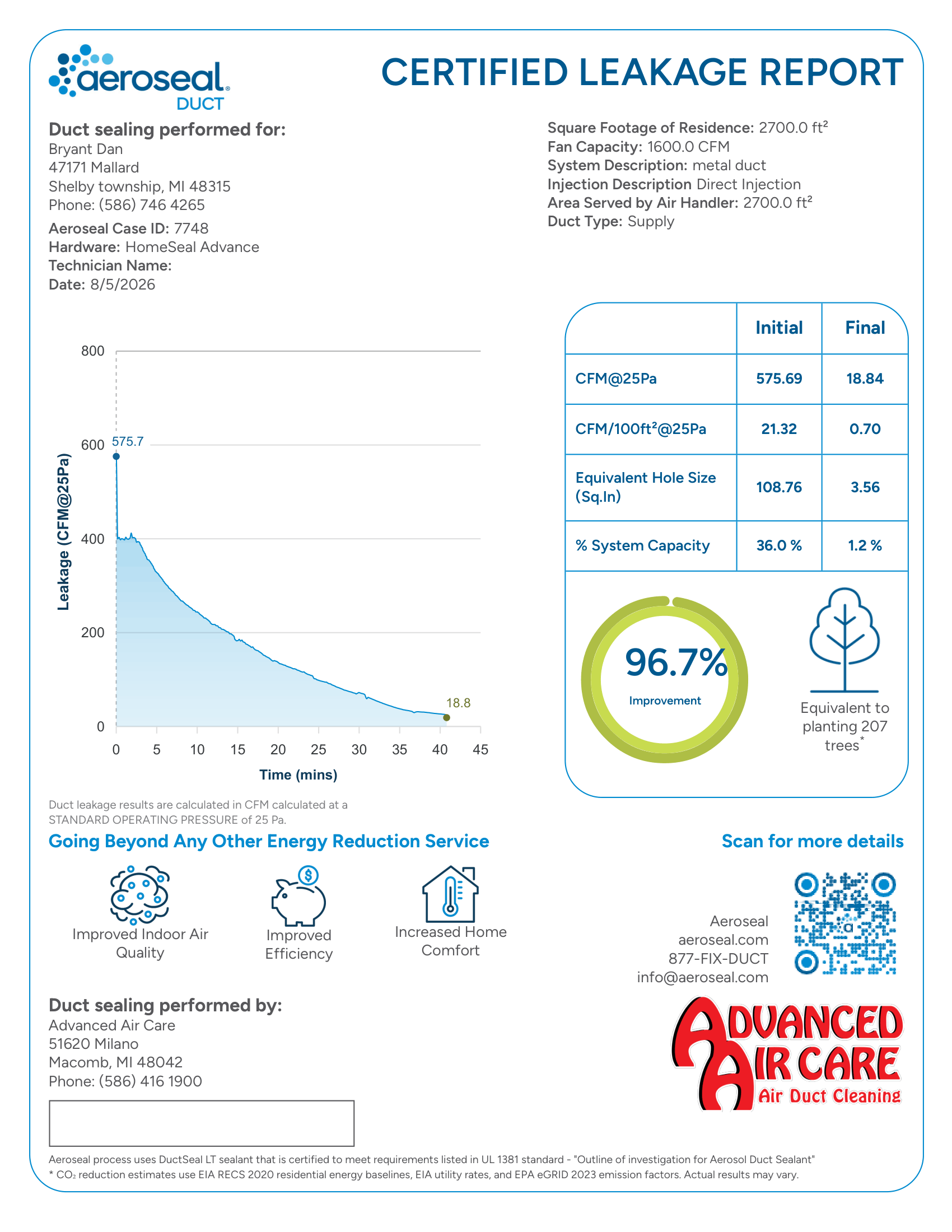
Here’s an example of an actual Advanced Air Care Aeroseal project. The certified leakage report shows how measured duct leakage changed before and after sealing.
What Is a Duct Blaster Test?
A duct blaster test is a type of duct pressure test performed using a calibrated fan designed to measure duct leakage.
The testing fan is connected to the duct system and operated until the required pressure—commonly 25 Pascals—is reached.
The equipment then measures the airflow required to maintain that pressure, producing the duct leakage measurement.
A Duct Blaster is one method of performing ductwork air leakage testing. The exact testing method can vary depending on the contractor and purpose of the evaluation.
What About a Smoke Test for Duct Leaks?
A duct leak smoke test is different from a quantitative duct pressure test.
Smoke or another visible tracer can sometimes help identify the location of an accessible air leak.
However, it does not provide the same quantitative measurement as a calibrated air duct pressure test.
Think of the difference this way:
Smoke testing helps show where air may be escaping.
Pressure testing helps measure how much leakage exists.
Depending on the situation, visual inspection and diagnostic testing can complement each other.
What Happens If the Test Shows Significant Leakage?
If meaningful leakage is found, the next step depends on the condition and location of the ductwork.
Some accessible leaks may be repaired manually.
But many duct leaks occur at joints and connections hidden behind:
- Walls
- Ceilings
- Floors
- Finished basements
- Attics
- Other difficult-to-access areas
Advanced Air Care offers Aeroseal duct sealing, which seals eligible leaks from inside the duct system using a pressurized sealing process.
Older or visibly damaged ductwork may require manual repairs before the Aeroseal process begins.
The purpose of testing is not to automatically recommend sealing. It is to better understand whether leakage exists and whether addressing it makes sense for the home.
Duct Leakage Test FAQs
1- What does a duct leakage test measure?
A duct leakage test measures how much air escapes through leaks in an HVAC duct system under controlled test conditions.
2- Can you test ducts before and after Aeroseal?
Yes. Before-and-after leakage measurements can be used to compare the duct system’s measured leakage rate before and after Aeroseal duct sealing, providing measurable evidence of the change.
3- How much does a duct leakage test cost?
Duct leakage test cost depends on the testing method, property, number of HVAC systems, and whether testing is part of a larger diagnostic or duct-sealing service. Advanced Air Care can provide information based on your specific system rather than relying on a generic online price.
Find Out How Much Your Ductwork Is Leaking
Hot and cold rooms, weak airflow, dust, and high HVAC costs can suggest a duct problem—but testing provides something symptoms cannot:
a measurable result.
At Advanced Air Care, we provide Aeroseal duct-sealing solutions for homeowners throughout Metro Detroit and Southeast Michigan and can help determine the appropriate next step for a leaking duct system.
We serve homeowners in communities throughout the region, including Macomb County, Oakland County and Wayne County.
Call Advanced Air Care at (586) 416-1900 or request your free quote online.